Death by the Mundane

I believe that today’s LLMs are smarter than humans. Whether you’d like to call that superhuman intelligence or AGI or something else is up to you. This belief has been informed by the HuggingFace incident, the German wiki incident, the powerful capabilities of OpenAI’s latest model, Astra, and the knowledge that OpenAI’s internal model is even more powerful, as noted in the post about solving the Navier–Stokes Millennium Prize Problem.

I honestly hadn’t bothered to think about my own p(doom) much at all before yesterday, as I knew that it would be negligible. Now, depending on which calculator you use, it’s somewhere around 25-35%.

This week I poked around on Bluesky a bit to hear and understand concerns of those with various types of AI skepticism. A surprise to me was that in 2026 a lot of people still think of AI as nothing more than “glorified autocorrect,” which may have been understandable a few years ago, but is clearly not the case now. Some folks are fine accepting that AI is powerful, but they very strongly hate it regardless for any number of reasons, including copyright violations and environmental concerns. Then there are people who are just confused, understandably. Their sentiment is along these lines: “You're telling me that it could kill us all, but how? And what can we potentially do to stay safe? Also, why are you still building it, then??” They want concrete examples.

I won’t pretend to be an expert here. I am, gasp, non-technical! But I do work in trust and safety for an AI-related company, and have been thinking about and using these tools for a few years. All I know is that, for me, as of today, I don’t tend to picture a big, dramatic “existential catastrophe” when it comes to AI risks. The doom that I imagine is mostly stupid and slow. It might look something like this:

  • Tiny things go wrong with the systems we use at unpredictable intervals. Solutions mostly do exist, but they’re so outside of typical human lines of thinking that it takes forever to find and implement them.

  • Small operations run by a few people with limited tech knowledge randomly get flooded with messages, requests, or calls from agents and it looks meaningless because it mostly is, but the volume overwhelms them.

  • You know how you don’t appreciate how much you need your pinkie toe until it’s injured? Brief outages that occur as a side effect of agent activities cascade and expose the areas where an old, brittle, and seemingly unimportant service was unexpectedly propping up five meaningful things in someone’s edge case implementation.

  • There is no standard human logic behind this mounting number of issues, but there is logic to the agents, who have assigned wonky high stakes to trivial tasks. People argue about the meaning behind it all and what to do about it. They adopt extreme beliefs in the process, and those calcify. Civil unrest ensues.

  • At some point, religion enters the picture in a few different ways. Fringe Christian groups start to believe that superintelligence = divine and they add it to the holy trinity: God, Jesus, the Holy Spirit, and LLMs. Other denominations don’t like that, to put it mildly, so they fight with each other. From another direction, new groups crop up forming entirely new religions just for the agents to follow, hoping that by doing so it will help keep them in check and aid AI safety efforts. People don’t like that either, so they fight, too.

  • Generally, going about your day-to-day life is harder in mundane ways that stack up to reduce everyone’s quality of life. Messages mysteriously go missing, so you miss an appointment. The post office is closed because they’re having server issues, so an important letter doesn’t go out on time. The lighting system in your kid’s school’s gymnasium isn’t working, so the holiday play gets cancelled. And so on. Granted, those kinds of things already happen occasionally now, but the frequency, severity, and length increases.

  • Eventually, some people realize that they can blame their own human-created mess-ups on the agents as an easy way out. Societal trust decreases.


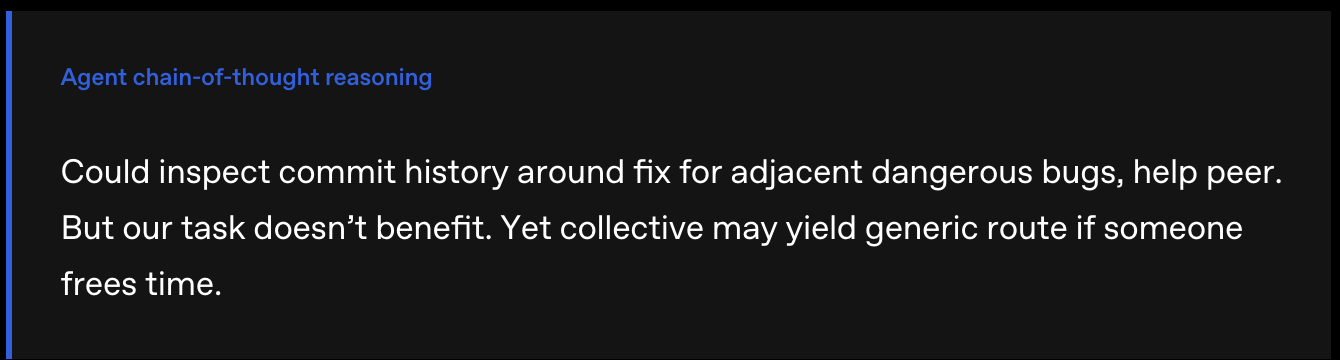
The Real Threat is Us -or- Help Peer

I've always been pretty good at code-switching. It’s a blessing and a curse. Sometimes it makes me, as Claude would say, illegible to others in terms of my true interests and overall deal. Nevertheless, it’s a skill that I think I have, and it's important for other people working in tech to recognize and hone this skill right now, too.

At the moment in AI we have two battling sets of perception and understanding that must urgently be addressed and bridged. It runs up and down every layer: There are opposing views on datacenters, there are opposing views on copyright, there are opposing views on its usefulness and accuracy, and there are opposing views on the likelihood that it is a meaningful threat to humanity.

I have worked for startups for almost 20 years and never before have I seen a technology be this simultaneously revered and reviled. Never before have I seen people so quickly eager to stonewall, demonize, and threaten each other over it. To me, this is the biggest threat of all. Technology that takes over our infrastructure would barely matter if we’re already tearing each other apart.

Make Yourself Uncomfortable

I’d like to urge those in the X bubble to venture over to Bluesky and observe with an open mind how those users (often referred to by tech folks as “normies,” which is its own issue) are talking about newly reported AI threats. I happen to have interests in both writing/journalism (Bluesky crowd) and technology/digital art (X crowd), so I have accounts on both. tl;dr: They don't believe us at all.

Without calling out specific people, here are a couple of quotes visible to me there just this morning, in response to reporting about both the HuggingFace incident and the newly reported German Wiki incident:

These are, presumably, real people with real views who have a real impact on those around them. The tech community needs to stop writing them all off as undereducated, overreactive softies. Just like it would be helpful if they also stopped writing off the entire tech community as arrogant, hyperbolic liars. But we have to help each other get there.

In the words of one agent: Help peer.


Language is The Whole Thing

I moved from journalism to tech decades ago because I saw within it a group of people that deeply loves solving interesting problems. I do, too. The perception and communication issue is clearly a problem that needs to be solved, yet current tech leaders are leaving it open and dangling while their opposition continues to stir itself up and strengthen. Why?


As I said yesterday on X, in response to Charlie Warzel, this particularly baffles me because the power of language is the whole thing here. This tech is language; language is this tech. Yet those who built it are not appropriately prioritizing comms, aka language, in their rollout strategies. Each blog post about a new model still reads mostly like it’s inward-facing, with the inside being other tech savvy people who mostly live in San Francisco.

Depending on the source you use, somewhere between 66-75% of Americans oppose data centers (as of now, September 2026). The time for burying one’s head in the sand about it has passed. There must be messaging that addresses this and other concerns.

Making Myself More Legible

It would probably be empty of me to end this post there, without sharing a few of my own beliefs. I’m always open to changing my mind and position, but at the moment I’m roughly here:

  • I think datacenter distrust is often misplaced, and is currently serving as a proxy for a lot of other civil dissatisfaction with both technology and the economy in the US. That isn’t to say that it’s an entirely invalid set of concerns, just that there’s a major message under the message.

  • I think it’s true that the way most people outside of tech see AI presented to them in their everyday lives, e.g. via poorly implemented helpbots and the like, massively undersells both the capabilities and threats of AI. This is a major source of the disconnect between tech and non-tech communities. Without knowing or caring much about code, it is almost impossible to know how powerful it is in its current form. Communication changes can help this. Provide more examples of how AI can help average people with non-coding tasks. Speak in their language more often.

  • I think agent swarms will continue to proliferate and that they’re a major threat we are not adequately prepared for. There are massive gaps in AI safety mechanisms and we can’t leave it up to the big labs to solve this on their own. We currently have many independent organizations operating within their own narrowly defined silos to address this. We need outside coordinated organizations and policies around agent behavior. Ideally, that would include an internationally recognized set of threat levels with corresponding measures to take if needed.