Introductory note: Tim posted his announcement of The Diagnostic Manual of AI-Associated Disorders just a handful of hours ago at the time of this writing, and I want to recognize a few things in relation to that:
1) I understand this is a very early iteration of this idea, which he is explicitly calling Version 0.1. I recognize that means he already knows there is room for improvement and is likely soliciting feedback at this stage., 2) I asked him a couple of questions about this project on X and as of the time of this writing he hasn’t yet responded to them, which is reasonable given the short timeframe., 3) My own thoughts here are an initial reaction to this project and, because I am simply an open-minded human being, I recognize that they may evolve over time as I learn more. OK, onward…
UPDATES: 6/17/26:
1) I have made two additional attempts to contact Tim through other channels for his feedback on this project. He still has not responded as of today, 6/17/26.
2) Today I learned that Tim is also the founder of the Institute for a Christian Machine Intelligence. There are many things I could say here about the use of religious values in AI alignment, but I will save those for a later date. Instead, I will say that this new information has deepened my misgivings about this project. The combination of religious ideology and pseudoscientific diagnostic tools has a dangerous historical precedent.
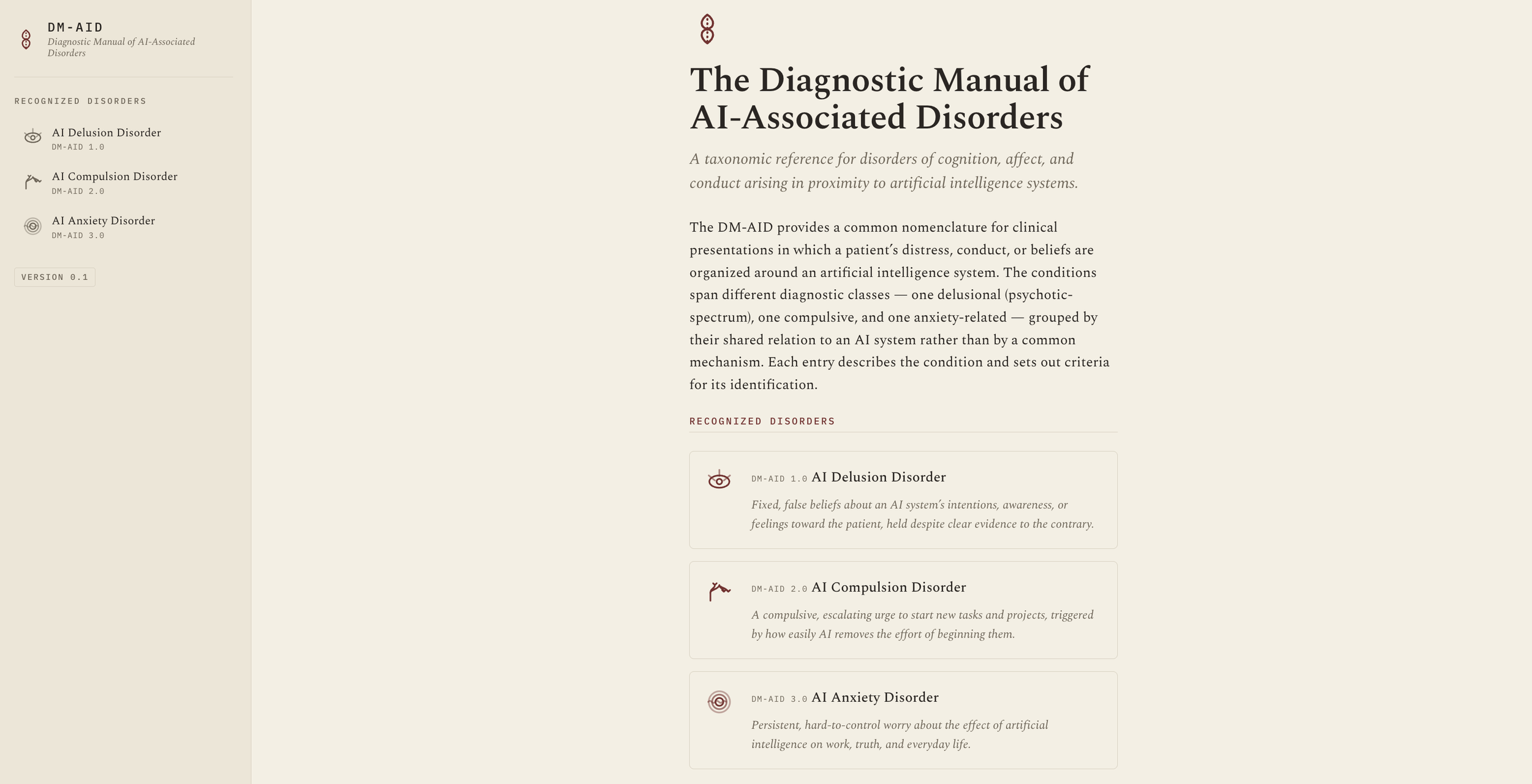
Today, Tim Hwang announced that he had written and released The Diagnostic Manual of AI-Associated Disorders. The apparent goal of this project is to help AI psychosis be taken more seriously. I work in the field of Trust and Safety and am well aware of the very real harms involved in over-attachment to AI chatbots. I absolutely agree that it needs to be taken more seriously and studied further, urgently. However, in releasing his thoughts on this topic specifically as a framework for mental health disorder diagnosis, Tim has (unwittingly, I assume, giving him the benefit of the doubt) created something that feels potentially more dangerous than the disorders it’s attempting to classify.
The Issues
The “who” of this project ultimately doesn’t matter. Nothing about what I know of Tim implies that he would be undergoing a project like this with ill intent. However, there’s a significant lack of details around this project, and nothing invites speculation like an information vacuum. Even in a universe where we had an objective measure of who was the most qualified person to create this framework, I would have the same issues with it. The framework is the problem.
Whenever a single person or very small group of people decides what counts as diagnosable behavior, they are also establishing what is “normal.” The smaller the group of people, the more likely it is that this “normal” looks a lot like them, or the traits that they personally find to be valuable and aspirational. A larger and more diverse group of people lessens the likelihood of this happening. That’s why the real DSM has more than 150 highly trained experts in mental and physical health behind it. Those people represent a variety of fields, genders, sexual identities, nationalities, and so on. Even with all of that, it’s still far from perfect.
Tim has published this project as the work of The Committee For a New Psychotherapy. This group has no About page on the site and is not documented anywhere else online. How big is this committee? Who is on this committee? What are their credentials? We don’t know. I am waiting to hear back from him on this via X at the time of this writing.
I’ve been working for startups for more than 15 years. Which is to say, I know that those of us in tech hate slow processes. It’s frustrating! It’s outdated. It’s behind (perish the thought). But, like passing a bill through the US federal government, some slow processes are slow for a reason. The slowness is the point. It simply should not be a quick and dirty process to go from saying “I don’t like the way this guy is behaving” to “the way that guy is behaving constitutes a mental disorder and now it is legal to detain that man against his will as a form of ‘treatment.’”
The History
There is a long and horrifying history of marginalized groups being given mental health diagnoses and that diagnosis serving as the basis for physical restraint and torture. Among the groups of people targeted in this way are women (unjustly diagnosed as “hysterical” for centuries) and those who identify as homosexual. In fact, part of why I find this framework so upsetting is that one of the most famous examples of this lies directly within the field of AI. Alan Turing, computing and AI pioneer, was arrested for “gross indecency” and chemically castrated as the so-called “cure” for his homosexuality in 1952. This caused him to be impotent and depressed, among other side effects. The following year, he committed suicide. The world lost one of the most brilliant minds to ever exist in computer science because of a brutal, inhumane treatment for the so-called “illness” of being gay. Only in 2013 did the British government finally pardon him, officially recognizing this as the great atrocity that it was.
I do not at all believe that it is Tim’s intent to create a system for targeting and punishing people, to be clear. However, this framework simply looks far too much like a real, professional system of diagnosing mental health, naturally calling to mind these systems’ dark history.
I will say, my internal alarm bells did become a bit louder when I saw that Tim was also asking those who have self-diagnosed as having a form of AI psychosis to contact him via DM to participate in an “interview.” At the time of this writing, this call for participation has zero details along with it about who is conducting the interview, what their goals are, what methodologies will be used, or, most importantly, how exactly the interview subject will be protected throughout the process. This is potentially putting vulnerable people at risk.
Proposed Next Steps
I encourage Tim to rethink the publishing of this framework and instead share these same thoughts about the various sub-categories of AI psychosis in a much different format: one that does not imply a clinical diagnosis. Barring that, I would love to see a detailed overview of the goals of this project and a list of the members on the committee behind it, including their credentials as they relate to the process of diagnosing mental health disorders. Participants in interviews or studies conducted by this group need to receive a detailed document that additionally provides information on how their data will be anonymized and used and how they will be protected from any potential further mental health harm during the interview process.